Sites & migration
A fast new website, or a move from WordPress to Astro with your content and search visibility protected.
Explore → Get a free quote →
Select a service to explore
A fast new website, or a move from WordPress to Astro with your content and search visibility protected.
Explore →Find out what holds back your visibility, then improve SEO, GEO and Google Ads with a clear action plan.
Explore →Save time on repetitive work with assistants and automations connected to your business.
Explore →Sell online and connect your operations with Shopify stores and custom business applications.
Explore →Keep your website secure, current and working while we handle updates and changes.
Explore →"A studio that is available, committed, and remarkably efficient. Consult them without hesitation if you want a dedicated, solution-oriented team to handle the design and development of your web projects."
From a CMS that copied every edition to a site the team runs on its own
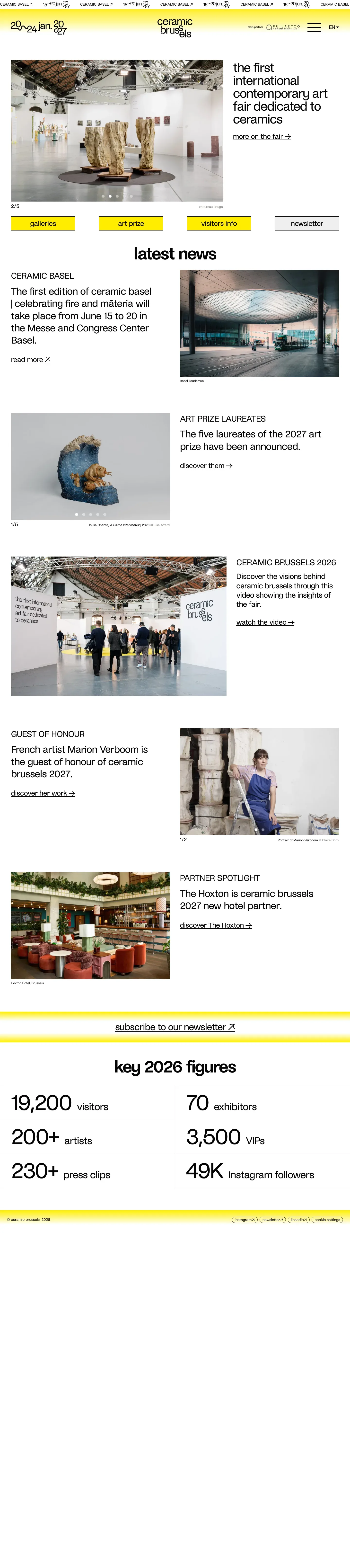
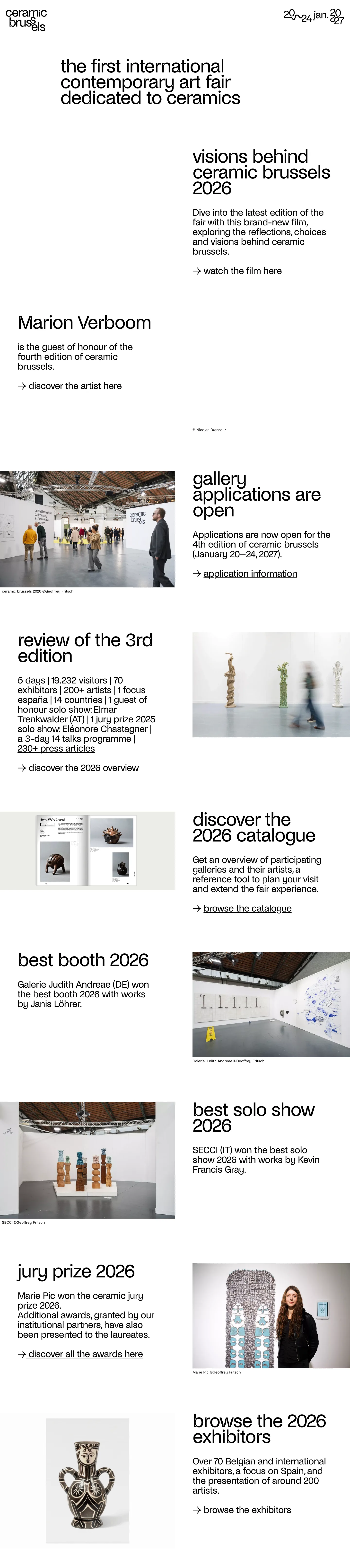
↔ Drag the slider to compare before and after
Laravel and Twill back office the team could not control
Every new edition built by duplicating last year's pages
143 galleries folded into accordions, no page of their own
10 URLs in the sitemap for about 117 real ones, no canonicals
Astro site with a Sanity Studio the team runs on its own
Editions as records, menus and submenus edited like pages
A shareable page for every gallery, filterable by country
Redirects, canonicals, real sitemap and structured data
An international art fair whose website the team could not update on its own. Ceramic Brussels is the first international contemporary art fair dedicated to ceramics, held every January at Tour & Taxis in Brussels and co-directed by Gilles Parmentier and Jean-Marc Dimanche. Three editions in, it had welcomed 143 galleries from 22 countries. Its website, built on Laravel with the Twill CMS, had not kept up. After building the Studio EMOSI website for the same team, we were asked to rebuild ceramic.brussels from the ground up.
The team described the problem in one sentence: the back office does not let us take control.
Publishing a new edition meant duplicating last year’s pages. The archive carried the scars, with addresses like guest-of-honour-3 and guest-of-honour-31, and numbered duplicates had reached the main menu itself. Adding a menu entry required a developer. For a fair that announces galleries, a programme and a guest of honour every autumn, every one of those announcements became a ticket.
We measured the site before quoting anything, and the numbers explained the rest. 191 exhibitor entries across three editions, 143 unique galleries, 904 images, all folded into three accordion pages with no page of their own. A gallery could not be shared by a link, found on Google or filtered by country, because the country was typed inside its name. Around 117 real URLs across three languages, against 10 declared in the sitemap, and not one canonical tag.
What had to be solved:
Ceramic Brussels does not look like an art fair template, and that was never negotiable. Its identity was created by Nathalie Pollet of the graphic design studio Pam&Jenny. Today Léonie Lefere manages the whole brand: she leads its graphic development and the evolution of every brand material, and she designed the website. That DNA is one you recognise in a second: the logo whose letters slip out of line like a pot leaving the wheel, the date written as a wave from 20 to 24, lowercase type everywhere, the Noi Grotesk typeface, and a yellow that runs from the top of every page into solid yellow buttons. The website is not decoration around the fair. It is one of the places where the brand lives.
That shaped the whole build, which we carried out in direct collaboration with Léonie and under her direction. We did not adapt the design to a theme, we turned Léonie’s Figma into the site’s design system: her type scale, her colours, her spacing, her layouts, coded as Astro components. And we drew the line between what the team controls and what stays fixed exactly there. Editors choose sections, write texts, place images, reorder pages and menus with complete freedom, but they compose with the brand’s own building blocks, so a new page cannot drift away from the identity. Full autonomy on the content, and a design that stays unmistakably Ceramic Brussels whoever publishes.
The biggest requirement was control, so the CMS choice carried the project. We compared hosted, git based and custom built options on the fair’s real volumes and its real team, and recommended Sanity for four reasons.
The team owns the editor. Sanity Studio, the editing interface, is code that lives in the client’s own repository. We configured and branded it for the fair, and it is theirs to keep, with or without us.
It costs nothing to run at their scale. The free plan covers 20 user accounts, 10,000 documents and 100 GB of media. Three editions, 143 galleries and every draft fit far below those limits. A custom CMS would have left the fair owning a tool nobody on its team could maintain.
The data stays in Belgium. Sanity stores content on Google Cloud in europe-west1, at Saint-Ghislain in Belgium, and exports in a single command. For a Brussels institution, that settles the GDPR question before it is asked.
Content is structured, not pasted. Sanity models what the fair actually handles, editions, exhibitors, programme, partners and pages, with real relations between them. That is what makes the end of page duplication possible.
The public site never queries Sanity directly. Astro generates static pages from the content at build time and Cloudflare serves them, so the editors get a modern CMS and the visitors get a fast, static site. We explain the trade offs in more depth in our guide to choosing a CMS for an Astro website.
A CMS the team runs alone. Editors create a page, choose its address, write its title and description for Google, compose it from the fair’s own section templates, and publish. The site rebuilds and the page is live within minutes, on desktop and mobile.
Menus and submenus as content. In the old site the menu was code. Now it is a navigation document the team edits like a page: add an entry, point it at a page or an external link, nest it one level down, drag it into place.
Editions instead of copies. Each edition is a record. Exhibitors, programme events, partners and awards are attached to it. The 2028 edition will be created in minutes by attaching its galleries, and the numbered duplicates are gone for good.
143 galleries with a page each. Every gallery is a single record, shared across editions, with its country as a real field. Visitors browse exhibitors by edition, by letter and by country, with filters for solo shows, awards and focus countries. Each gallery now has a link it can share and a page Google can index.
Three editions migrated by script. The 2024, 2025 and 2026 editions, 191 participations and 904 images were imported into Sanity, attached to the right gallery and the right year, and checked record by record.
Languages written by people. Each document carries its translations side by side in Sanity, so a gallery’s booth, country and images are entered once and its texts are written by people in each language. English and French launched together, and the structure is ready for Dutch.
An SEO migration, not just a launch. The old URLs that Google and visitors actually used were checked against Search Console data and redirected to their new pages, every page got its own title, description and canonical tag, the sitemap now declares the real site, and Event and Organization structured data describe the fair to search engines. Google Analytics 4 and Microsoft Clarity measure the audience the fair asked to see.
The project ran with the fair’s team, not around it. A kickoff meeting in August, the design and the old CMS access shared the same day, a presentation of the solution in early September, then review sessions where the editors used the CMS on real content before launch. Day to day, requests from the design, content and communication team came in through a shared group, were labelled, and went into the build in short cycles. The DNS move to Cloudflare happened ahead of the switch, with every existing record copied first, so the fair’s email never noticed.
Live on www.ceramic.brussels on 6 October 2026, ahead of the autumn announcements for the January 2027 edition.
The team publishes without us. Pages, menus, galleries and news are created and published by the fair’s editors, who are the people who know the content, and every page they publish still looks like Ceramic Brussels.
143 galleries findable on Google, each with its own page and country, where before there was nothing to link to.
100/100 on accessibility, best practices and SEO, measured on PageSpeed Insights in October 2026, with 100/100 on desktop performance.
One design system, two fairs. The components we built for Brussels became the starting point for the fair’s second website, Ceramic Basel, live in October 2026.
In June 2027 the duo behind Ceramic Brussels opens a second fair: Ceramic Basel, 15 to 20 June at the Messe & Congress Center in Basel, during the most influential week of the art world, with 65 international galleries for its first edition. It needed its website months ahead, to open applications and announce the fair.
Léonie’s brief for it was clear: the same fonts, the same text styles, the same slideshows and the same layouts as Ceramic Brussels. Because the Brussels design already existed as a coded design system, we did not start from zero. We carried the components over, recoloured them from the Brussels yellow to the Basel gold, and built the nine pages of her new Figma in French, English and Dutch. The two sites link to each other, each wearing the other’s colour on those links, so a visitor feels they belong to the same family.
Ceramic Basel launched as a static site, since a fair that has not happened yet has little content to manage. When it grows, it can move to Sanity the way Brussels did.
A cultural institution should not need a developer to announce its own programme. The value of this project is not the stack. It is that the people who run the fair can now run the website too, and that the website finally shows the galleries the fair exists to present.
Custom features that drive real business value
A branded Sanity Studio in the client's own repository: editors create, compose and publish pages without a developer.
The navigation is a document the team edits like a page, with two levels and drag and drop ordering.
Each edition is a record with its exhibitors, programme and partners attached. No more duplicated pages.
143 galleries with their own page, country field and filters by edition, letter and country.
The designer's Figma became the design system. Editors compose with the brand's own blocks, so every page stays Ceramic Brussels.
Redirects checked against Search Console, canonicals, a real sitemap, Event and Organization structured data.
From kickoff in August to a live site on 6 October 2026
Old site inventoried, content model designed around editions, galleries, programme and pages.
Figma turned into Astro components, Sanity Studio configured and branded for the editors.
Three editions, 143 galleries and 904 images imported by script and checked record by record.
Redirects, DNS switch, analytics, and editors publishing on their own.
 Astro
 Sanity Cloudflare Pages
 Figma
 Google Analytics 4
 Microsoft Clarity Schema.org
A studio that is available, committed, and remarkably efficient. Consult them without hesitation if you want a dedicated, solution-oriented team to handle the design and development of your web projects.
Whether you're struggling with platform limitations, need custom functionality, or want to migrate to a more flexible solution, we have the expertise to deliver results.